

Why AI Conversations Need a Map, Not Just a Thread
Linear chat is fine for quick answers. Complex AI work needs multiple paths, comparison, and a way to return to earlier decision points.
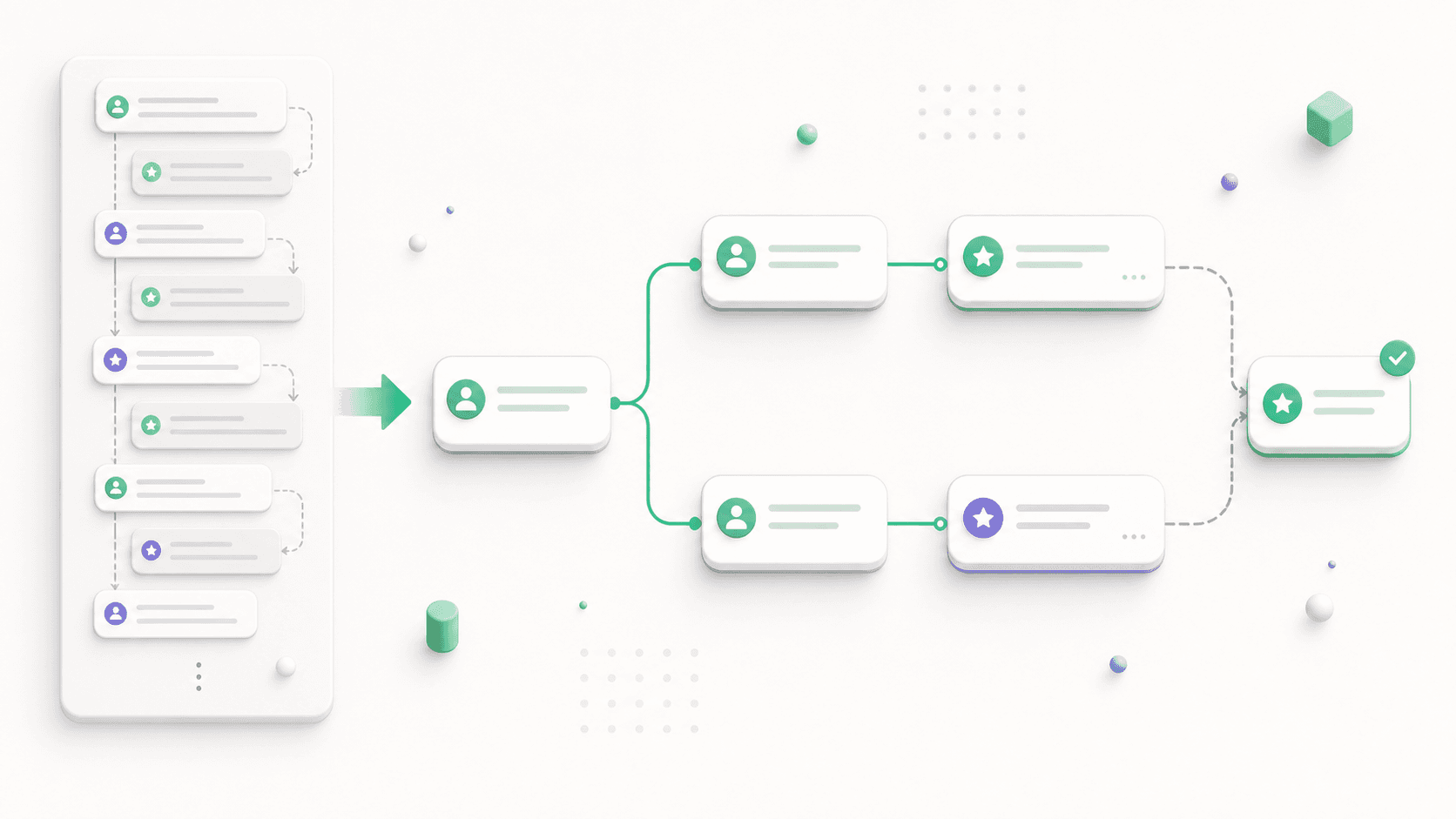
Most AI conversations still look like messaging apps: one message after another, stacked in a single scroll. That works for simple questions. It breaks down when the work becomes exploratory.
Research, strategy, writing, debugging, and product decisions rarely move in one straight line. You ask an initial question, get a useful answer, then realize there are three different directions worth exploring. In a normal chat, you pick one and the others disappear.
The problem is not the model. The problem is the shape of the workspace.
Linear Chat Forces Premature Choices
Linear chat makes every follow-up compete for the same space. If you go deeper on one direction, the conversation moves forward and the other direction becomes harder to recover.
That creates a subtle cost:
- You lose promising alternatives.
- You mix unrelated explorations in one thread.
- You repeat context when you open a new chat.
- You cannot easily compare where different directions led.
For quick answers, that cost is small. For serious thinking, it compounds.
A Conversation Map Fits the Work Better
A conversation map treats earlier messages as decision points. When the AI gives an answer with multiple possible directions, you can open separate paths from that moment.
For example, imagine you ask:
Should we launch self-serve pricing or sales-led plans first?
The AI gives a balanced answer. From there, you might open two paths:
- What would self-serve look like in the first 30 days?
- What would sales-led teach us that self-serve would miss?
Each path keeps the shared context. Each path gets its own follow-up question and answer. You can compare them without turning one conversation into a tangled scroll.
The Map Is the Productive Part
The value is not just visual. The map changes the workflow:
You can return to earlier points. If a path becomes weak, go back to the moment before it and try another direction.
You can compare alternatives. Two answers are easier to evaluate when they are separate, not buried 20 messages apart.
You can synthesize. After exploring different paths, combine the strongest ideas into a decision, draft, plan, or memo.
You can share reasoning. A map shows how the work developed. A transcript only shows what happened in order.
When a Map Is Worth It
You do not need this structure for every AI task. A single translation, a quick code snippet, or a factual answer does not need a map.
Use a conversation map when the task has real alternatives:
| Task | Why a map helps |
|---|---|
| Product decisions | Compare tradeoffs without losing the original context |
| Research | Explore sub-questions from the same foundation |
| Writing | Try multiple structures or tones without overwriting drafts |
| Debugging | Test different hypotheses separately |
| Strategy | Keep optimistic, skeptical, and practical views distinct |
Better AI Work Needs Better Shape
AI is increasingly used for open-ended work. Open-ended work needs structure. A single thread is not enough when the goal is to explore, compare, and decide.
TalkTree is built around that idea: start from any message, open another path, compare what happens, and bring the best parts back together.
Try the workflow in TalkTree
Open the demo workspace and explore AI conversations as maps.