

Linear AI Chat vs. Conversation Maps: A Practical Comparison
When should you use a normal AI chat, and when does a visual conversation map help? A practical comparison for research, writing, coding, and decisions.
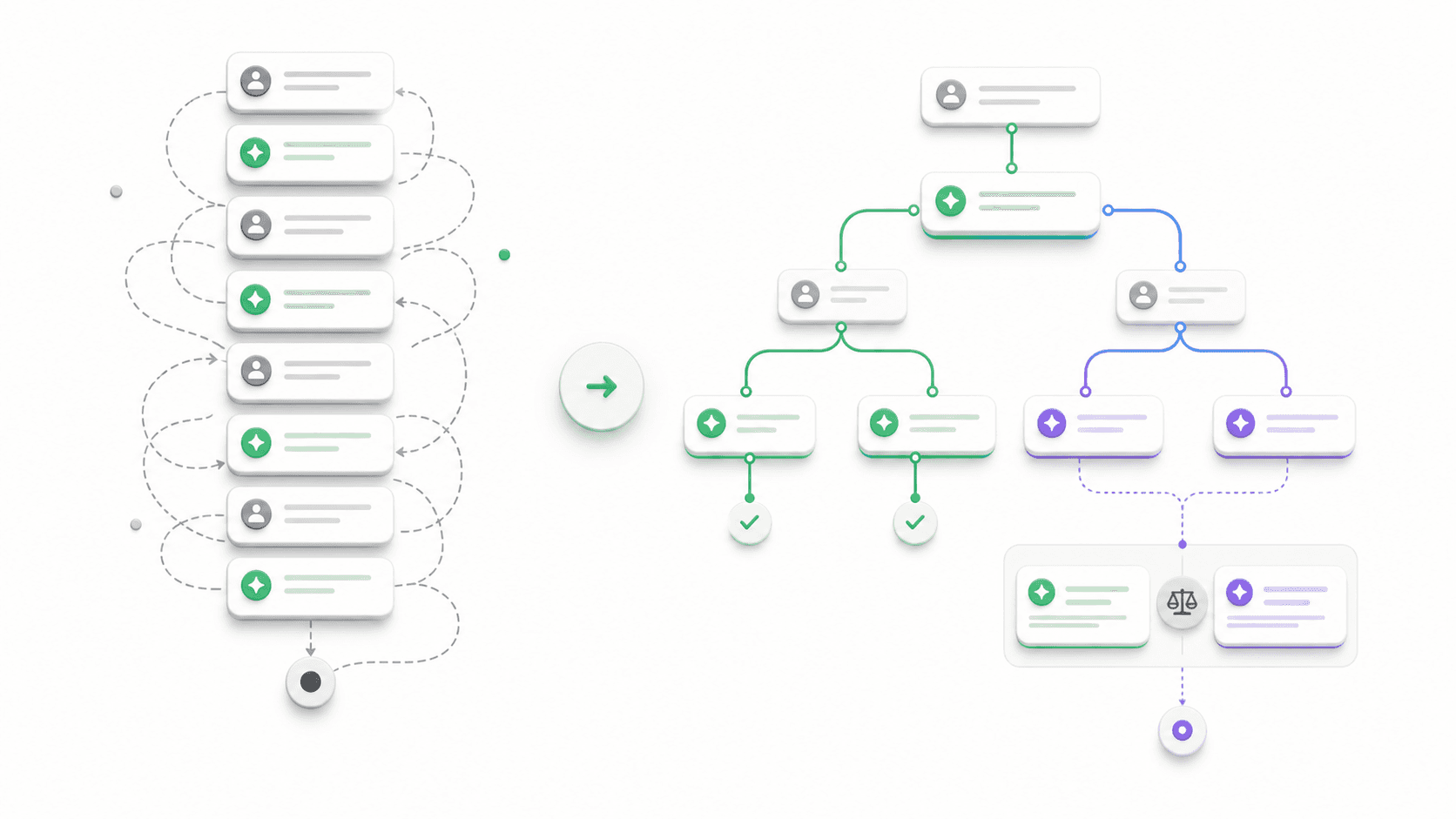
Linear AI chat is fast, familiar, and good for direct tasks. Conversation maps are better when the work has alternatives: different questions to ask, different viewpoints to test, or different outputs to compare.
The point is not that one interface is always better. The point is matching the shape of the tool to the shape of the work.
Research and Analysis
Linear chat: You ask a research question, get an answer, then keep asking follow-ups in the same thread. This works until you need to explore several sub-questions at once. Then the thread becomes a mix of hypotheses, evidence, and half-finished directions.
Conversation map: You establish the research context once, then open separate paths for competing explanations, source checks, objections, or next questions. Each path starts from the same foundation, so you do not re-explain the topic.
Best fit: Conversation map for deep research. Linear chat for quick lookups.
Writing and Content Creation
Linear chat: You draft and revise in one flow. If you want to try a different opening, structure, or tone, you either overwrite the current version or copy content somewhere else.
Conversation map: Each draft direction can live as its own path. One path explores a direct opening. Another explores a story-led opening. Another tries a more technical version. You can compare them before choosing.
Best fit: Conversation map for serious drafting. Linear chat for short edits.
Coding and Technical Problem-Solving
Linear chat: You describe a bug or architecture question and iterate. If you want to compare two approaches, the thread can become noisy: one answer assumes a library, another assumes a custom implementation, and the context starts to blur.
Conversation map: Open separate paths for different approaches: recursive vs. iterative, library vs. custom, performance-first vs. simplicity-first. Keep the assumptions separate until you are ready to decide.
Best fit: Conversation map for architecture and debugging hypotheses. Linear chat for small snippets.
Strategy and Decisions
Linear chat: You ask for pros and cons, then keep asking follow-ups. The problem is that a decision often needs multiple lenses: optimistic, skeptical, financial, technical, customer-focused.
Conversation map: Put each lens on its own path. Ask different follow-up questions. Then compare what each path reveals and synthesize the decision.
Best fit: Conversation map for decisions with real tradeoffs.
Brainstorming
Linear chat: Brainstorming produces many ideas, but the thread turns into a long list. Developing one idea means pushing the others out of view.
Conversation map: Each promising idea can become a path. You can develop several ideas without losing the original list or mixing unrelated directions.
Best fit: Conversation map, especially when you need to return to ideas later.
Quick Q&A and Simple Tasks
Linear chat: For a factual question, translation, small transformation, or single-step code answer, linear chat is enough.
Conversation map: It still works, but the structure may be unnecessary.
Best fit: Linear chat.
Summary Table
| Use Case | Better Fit |
|---|---|
| Quick factual question | Linear chat |
| Simple code snippet | Linear chat |
| Deep research | Conversation map |
| Long-form writing | Conversation map |
| Architecture decision | Conversation map |
| Product strategy | Conversation map |
| Brainstorming | Conversation map |
| Comparing viewpoints | Conversation map |
| Turning exploration into a memo | Conversation map |
The Practical Rule
Use linear chat when you already know what you want.
Use a conversation map when you need to explore what is worth asking next.
TalkTree is designed for the second case: start from any message, open another path, compare the answers, and synthesize the strongest direction.
Try the workflow in TalkTree
Open the demo workspace and explore AI conversations as maps.